Unlocking organizational potential with people data
In high-growth, high-pressure environments, leadership clarity matters, and it comes from better-quality data about your workforce. Your ability to lead people with speed and accuracy depends on a system that provides timely, relevant signals built for how people actually work.
In high-growth, high-pressure environments, leadership clarity matters. But clarity doesn’t come from more dashboards. It comes from better-quality inputs.
Most executive teams are still making people decisions using outdated, incomplete, or overly filtered data. The problem isn’t how much information they have, it’s how much of it they can trust. Surveys, check-ins, and opinion-based tools were built for HR compliance, not for strategic decision-making. The signals they provide often come too late or lack the consistency and granularity leaders need to act with confidence.
In today’s environment, you need a different kind of intelligence. Your ability to lead people with speed and accuracy depends on a system that provides timely, relevant signals built for how people actually work.
The cost of leading without clarity
Turnover, falling commitment, and cultural strain don’t show up without warning. They build quietly through drops in energy or motivation, weakened alignment, and distance between teams and goals.
When leaders only see these issues once KPIs are affected, the damage is already underway.
Consider this: in a 2023 Deloitte report, roughly 80% of C-suite executives said their employees’ well-being had improved over the previous year, while on average only 32% of employees said the same (reported by Fortune). A gap like this affects program design, timing, and investment. Misreading the state of your workforce leads to missed interventions, reduced trust, and slower execution.
When your view of organizational health relies on lagging indicators or on a single point of view, even well-intended decisions can carry risk.
When measurement falls short
Traditional tools depend on consistent self-reporting. But participation is uneven, and responses are often shaped by internal politics, workload, or fatigue. In some cases, people may not even be fully aware of how they’re doing, especially in fast-moving or high-pressure environments. As a result, the data you collect may not show clearly how your teams are working.
And when feedback is filtered through multiple systems (such as HRIS platforms, survey tools, and disconnected dashboards), the data loses clarity and relevance.
This creates blind spots. Leaders are asked to make high-impact decisions without a reliable understanding of how teams are functioning or what’s driving operational friction.
The more pressure an organization is under, the more costly these blind spots become.
A better alternative: operational data that complements feedback
Feedback can be a powerful tool for driving meaningful change, but it can miss deeper patterns that shape performance and resilience. What leaders need is not a replacement, but a more complete view: a way to fill those blind spots with structured signals about how teams are doing.
By surfacing consistent signals, validated against reference psychometric questionnaires, on dimensions like motivation, burnout risk, and resilience, these measures add depth to existing feedback systems.
The result is a broader foundation for decision-making. One that respects feedback, but strengthens it with continuous visibility into how people are coping with the demands of work, across teams, cycles, and changing conditions.
Why this matters at the executive level
This isn’t just an HR conversation. It’s about whether your leadership team has the visibility to make people decisions with the same precision applied to finance, operations, or growth strategy.
Executives are being asked to lead through constant complexity, whether it’s uncertainty, restructuring, fast-paced hiring, or cultural change. When the well-being of your workforce becomes a blind spot, every strategic choice becomes harder to execute and sustain.
With the right system in place, leadership gains the ability to:
- Spot early signs of burnout risk or falling commitment before performance is affected
- Assess whether teams have the capacity to carry through a transformation
- Align people strategy with operational demand
- Give HR a decision-making role grounded in reliable, repeatable data
That shift turns well-being from a siloed initiative into a core input for planning and leadership.
Solving the right problem: an illustrative scenario
The following is a hypothetical scenario, not a client case. Imagine a global tech company that sees performance drops in several sales regions. Revenue pressure is building, and leadership is preparing to restructure.
Standard tools show no clear issues: survey scores look stable and turnover remains low.
But when the company looks at its team well-being data, a different pattern appears: in two key geographies, motivation indicators have dropped. Manager workload surged after a reorganization, and teams show signs of strain.
Instead of adding new layers of management, the company rebalances team load, clarifies roles, and gives teams room to recover. The point of the example is the order of events: without that extra layer of information, the company would risk misdiagnosing the problem and making it worse.
Leading with precision
High-stakes decisions rely on high-integrity data. You wouldn’t sign off on a financial model with weak assumptions, and the same standard should apply to workforce strategy.
This requires moving past reactive metrics and toward consistent, longitudinal signals that give every C-level leader the visibility they need.
Leading organizations are already making this shift. They’re:
- Tying workforce health to strategic KPIs
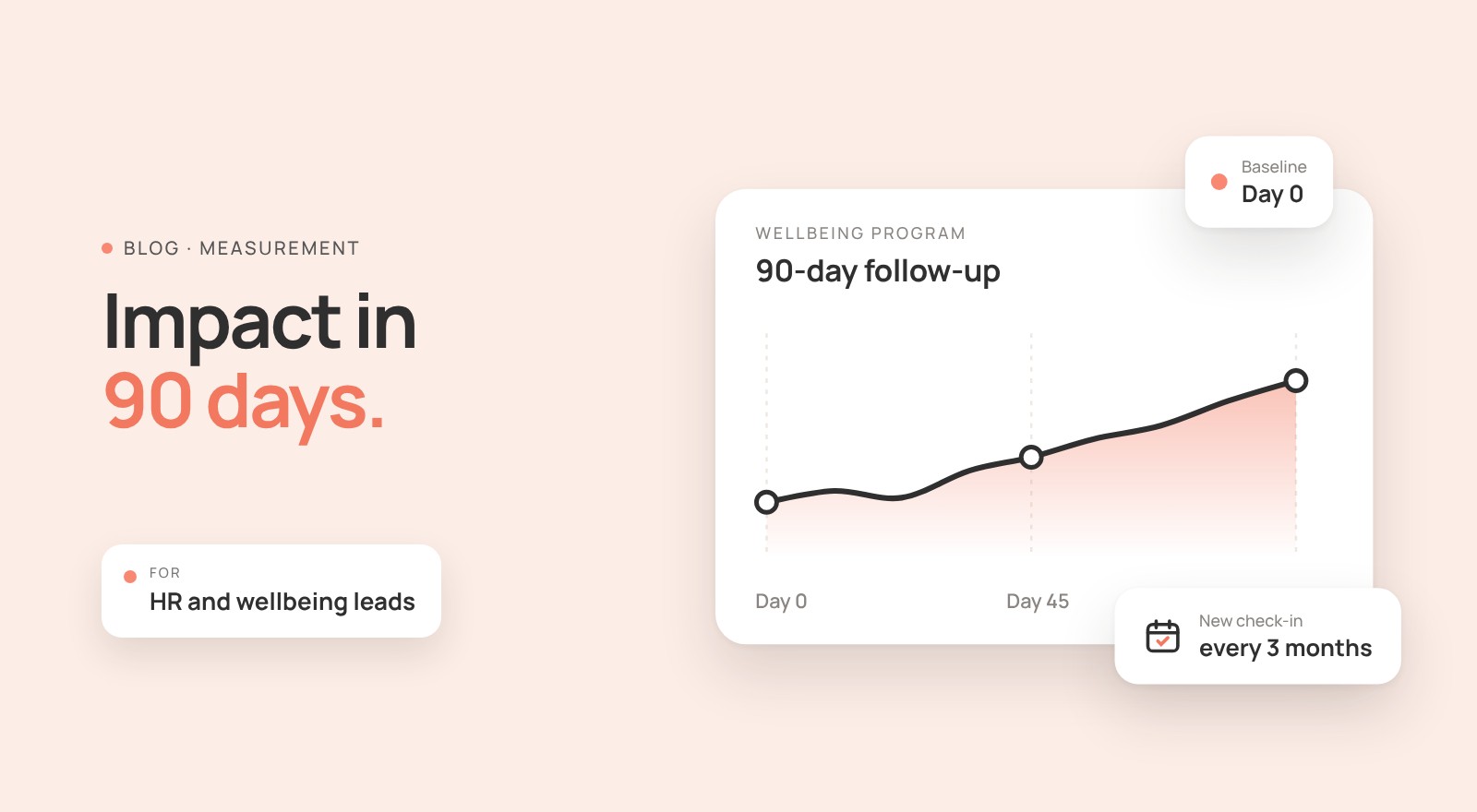
- Requiring ROI validation for well-being and commitment programs (our guide to measuring impact in 90 days shows how)
- Using early signals to shape transformation planning
- Equipping HR with tools that connect directly to performance
The goal isn’t to collect more data. It’s to collect the kind that supports sharper, faster action and that is aligned with how your teams actually work.
Clarity is no longer optional
Resilient organizations adapt quickly, not just structurally, but also operationally and culturally. To do so, they need a clear understanding of how conditions are affecting the people who carry the strategy forward.
Modern well-being data makes that possible. It shows how pressure is building, where support is needed, and when systems are starting to fail.
Because sustainable performance depends on more than targets. It depends on the health of the people responsible for delivering them.
And without visibility into those conditions, leadership is always one step behind.
If your leadership team is rethinking how it tracks organizational health, it may be time to replace reactive reports with forward-looking signals. Learn how Motional Hub supports CEOs and executive teams, or book a conversation to see how early visibility supports better strategic decisions.
Better well-being starts with better insight
Explore practical tips, expert advice, and real-world use cases to help your teams thrive.